
If your platform pays international contractors, freelancers, or gig workers, you’re probably familiar with Form 1042-S. The form reports payments made to foreign persons and any tax withheld on that income. Filing is required for each foreign payee who receives reportable income—even if no tax was withheld. For businesses running API-driven disbursements to thousands of foreign participants, staying compliant means tracking W-8 documentation, calculating withholding correctly, and meeting the March deadline without manual bottlenecks.
This guide breaks down everything you need to know about Form 1042-S, from basic requirements to automation strategies that help you stay compliant while scaling globally.
Note: While automation significantly improves the 1099 filing process, always consult with your tax professional regarding your specific filing requirements and obligations. This article is neither legal advice nor tax advice. We recommend that you speak to your tax advisor with any questions or concerns around tax reporting.
TLDR:
- Form 1042-S reports payments to foreign contractors and must be filed by March 16, 2026 for each payee.
- You must file even if no tax was withheld; the form tracks U.S.-source income paid to non-residents.
- Correct income codes (17-20 for gig workers, 12 for royalties) prevent misreporting penalties.
- Routable automates W-8 collection, form validation, and 1042-S filing for high-volume international payouts.
What is Form 1042-S?
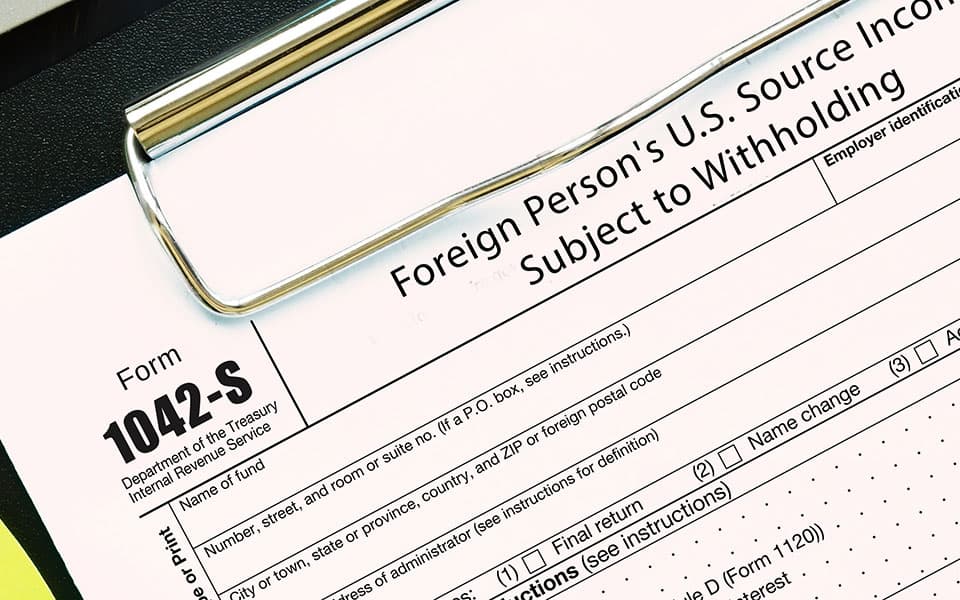
Form 1042-S, titled Foreign Person’s U.S. Source Income Subject to Withholding, is an information form to report year-end amounts paid to non-U.S. residents, partnerships and corporations. The IRS uses this form to monitor U.S.-earned income by foreign persons and to verify amounts owed by taxpayers.
Companies operating marketplaces, creator networks, or gig apps with international payees use this form to document payments made to non-U.S. participants and the corresponding tax withholding. This form must be filed even if the business is not responsible for income tax withholding for the contractor.
For a copy of 1042-S and detailed instructions from IRS publication, visit U.S. IRS website or, if available, the Foreign National Information System (FNIS) website provided by an employer or organization to learn more about possible tax treaty benefits.
What is Form 1042-S Used For?
The 1042-S is used to report income earned from a U.S. source by a nonresident for any wages or other type of income, compensation, scholarships, fellowships, royalties, tuition, etc., as defined in the form’s instructions.
The 1042-S is somewhat similar to the information form 1099-NEC that a business files for the entire amount paid to a freelancer or contractor with the main difference being the citizen status of the person who was paid. Like the 1099-NEC, in most cases the withholding officer also sends a copy of the 1042-S to the nonresident contractor who will then use that form to determine if they must file a tax return and what, if any, is owed on a tax return. However, unlike the 1099-NEC, which is always used to file income tax, the 1042-S is not due to the IRS until March 15 each year, as it is not necessarily used to file income taxes. When March 15 falls on a weekend or legal holiday, the due date shifts to the next business day. Both forms are information forms meaning that they help the IRS to track U.S. earned income.

Who Must File Form 1042-S?
If there has been payment in any amount to a non-resident (whether earned income or other forms of payment), federal tax law requires that a withholding agent from the U.S. source must file Form 1042-S to document those amounts. These payments fall under one of three payment types:
- Interest income: paid on real property mortgages, paid by foreign corporations, tax-free covenant bonds, etc.
- Dividend income: paid by U.S. corporations, paid by foreign corporations, dividends as a substitute payment, etc.
- Other income: industrial royalties, scholarship or fellowship grants, compensation for teaching or studying, gambling winnings, capital gains distributions, etc.
This includes marketplaces, gig economy apps, and creator networks paying international contractors, drivers, sellers, or freelancers. Filing obligations apply per foreign payee who receives reportable income—even if no tax was withheld. Payment control triggers the requirement, not the withholding itself.
How to Fill out IRS Form 1042-S
Form 1042-S requires the following information to be recorded and filed. A separate 1042-S should be filed for each type of payment made to an individual.
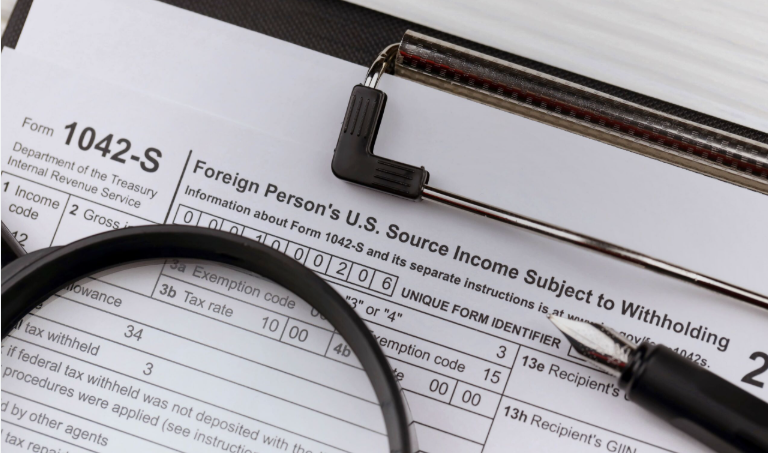
Income Code (Box 1)
A two-digit code that signifies what type of payment was made. For example: television copyright royalties (11) or independent personal services (17). Form 1042-S uses 61 distinct income codes to classify payment types. Three codes (59-61) were added in 2025. Choosing the wrong code triggers misreporting penalties and incorrect withholding calculations.
Four code groups cover most mass payout scenarios:
- Codes 17-20 classify compensation for personal services, including independent contractor fees and gig worker earnings paid to drivers, taskers, or service providers.
- Code 12 reports royalties paid to musicians, content creators, or rights holders for use of their work.
- Codes 06 and 07 cover dividend distributions if you’re paying investment income to foreign payees.
- Code 23 serves as the catch-all for miscellaneous income that doesn’t fit other categories.
If a payee receives multiple income types, file separate Form 1042-S forms per income code. Document your code selection logic; audits review whether you applied the most specific code for each payment type.
Gross Income (Box 2)
The total, or gross amount paid to the individual for the specific income code in Box 1. This is not a net income.
Chapter Indicator (Box 3)
If the recipient is a foreign person, they are Chapter 3. If the recipient is a foreign financial institution, it is Chapter 4.
Exemption Code (Box 3a or Box 4a) and Tax Rate (Box 3b or Box 4b)
The chapter the payments fall under determines which exemption code, if any, and tax rate apply. It is best practice to use the Form 1042-S instructions to determine which exemption code and tax rate to use.
Withholding Allowance (Box 5) and Net Income (Box 6)
This box only applies to specific income codes reported in Box 1 where special rules may apply. These include fellowship grants to scholars, compensation for independent personal services, compensation for dependent personal services, compensation for teaching, compensation during studying or training, and earnings as an artist or athlete. Filling in an amount in Box 6 is initiated by filling in an amount in Box 5. Otherwise, it is left blank.
Total Withholding Credit (Box 7a-11)
These boxes are used to report various instances of federal tax that have been withheld. Use the IRS Form 1042-S instructions to determine which boxes apply. In all cases, 7a must be filled in even if the amount is zero.
Withholding Agent Identifying Information (Box 12a- Box 12i)
These boxes are used to fill in the identifying information for the withholding agent filing the 1042-S. The withholding agent must provide an employer identification number (EIN), Ch 3 and Ch 4 status code (both are required), global intermediary identification code (GIIN), country code and a foreign tax identification number if available.
Recipient Identifying Information (Box 13a-Box 13l)
These boxes are used to fill in identifying information for the recipient of 1042-S payments including the recipient’s name and address, recipient’s country code, recipient status code, individual taxpayer identification number (ITIN), GIIN, LOB code and foreign tax identification number if available.
State Income Tax (Box 17a-c)
If there has been any state taxes withheld from the payments, these are reported as well as the state tax number and state code.
Automating 1042-S Compliance for High-Volume Payments
When you’re processing hundreds of international disbursements monthly, 1042-S compliance creates a scaling bottleneck. Manual W-8 collection, form validation across shifting regulations, expiration tracking, and preparing separate returns for each foreign payee drains capacity that should go toward growing your creator, driver, or seller network.
Routable automates the entire workflow. When you onboard international payees through our white-label portal, the system collects W-8 forms, validates required fields, and stores documentation linked to each payee record. We flag which recipients need 1042-S filing versus 1099 forms based on their tax documentation, prepare and electronically file returns, monitor W-8 expiration dates, and maintain compliance records year-round.
For businesses disbursing to thousands of foreign payees via API or CSV upload, automation removes the headcount constraint. You scale international payment volume without adding compliance staff to chase paperwork or manually reconcile withholding across recipient populations.
Final Thoughts on Managing Form 1042-S
When you’re paying foreign creators, gig workers, or sellers at scale, 1042-S filing quickly becomes a manual nightmare. Chasing W-8 forms, validating documentation, and preparing individual returns for thousands of payees pulls resources away from growth. Routable automates the workflow end-to-end so compliance scales with your international disbursements.
FAQ
How do I know which income code to use on Form 1042-S for gig workers?
Use codes 17-20 for independent contractor fees and gig worker earnings paid to drivers, taskers, or service providers. Code 12 applies to royalties for musicians or content creators, while code 23 serves as the catch-all for miscellaneous income that doesn’t fit other categories.
Do I need to file Form 1042-S if I didn’t withhold any taxes from my international payees?
Yes, you must file Form 1042-S even if no tax was withheld. The form tracks U.S.-source income paid to non-residents, and filing obligations apply per foreign payee who receives reportable income—payment control triggers the requirement, not the withholding itself.
What’s the deadline for filing Form 1042-S?
Form 1042-S must be filed by March 15 each year for payments made during the previous calendar year. When March 15 falls on a weekend or legal holiday, the due date shifts to the next business day.
Can I file one Form 1042-S for a payee who received multiple payment types?
No, you must file separate Form 1042-S forms for each income code. If a creator receives both royalty payments (code 12) and independent contractor fees (code 17), you’ll need to submit two separate forms documenting each payment type.
How does 1042-S filing scale when I’m paying thousands of international creators or drivers?
Manual W-8 collection and form preparation creates a bottleneck at scale. Automation platforms handle W-8 collection during onboarding, validate documentation, flag which recipients need 1042-S versus 1099 forms, and prepare returns—letting you scale international disbursements without adding compliance headcount.