

When was the last time you had to explain to a frustrated creator or driver why their payment was delayed? If you’re managing high-volume payouts, you know that speed and reliability directly impact partner retention. Scalable payment operations require purpose-built infrastructure with real-time payment rails, automated compliance, and APIs your team can integrate in days, not months. We ranked the best solutions for operators who need to move money quickly to thousands of payees without the overhead of traditional finance software.
TLDR:
- High-volume payout solutions automate thousands of monthly payments to creators, drivers, and sellers.
- Best platforms offer API-first design, idempotency keys, and 10+ payment rails including instant RTP.
- Automated tax compliance (W-8/W-9 collection, 1099 filing) prevents manual bottlenecks at scale
- Routable handles 10,000+ monthly payments with 99.8% ERP sync accuracy and 30-50% FX savings across 220+ countries.
What Are High-Volume Payout Solutions?
High-volume payout solutions are specialized technologies that automate the process of sending thousands or millions of payments to large networks of payees. These systems handle disbursements to creators, drivers, gig workers, sellers, and other partners at scale.
Companies typically need dedicated disbursement infrastructure when they process 1,000+ monthly payments. At that volume, manual processes break down and traditional accounts payable software falls short.
Unlike traditional AP systems built around invoice processing and approval chains, high-volume payout solutions prioritize different capabilities. They focus on speed, API connectivity, and payee experience. The goal is moving money quickly and reliably to large networks, not managing purchase orders or three-way matching.
These solutions enable businesses to send payments programmatically through CSV uploads or API calls. They support multiple payment rails, handle international disbursements, and give payees transparency into when and how they’ll be paid. For marketplaces and gig economy platforms, payout speed and flexibility directly impact partner retention and competitive positioning. Choosing the best mass payout platforms requires careful evaluation of your specific needs.
Core Capabilities of High-Volume Payout Solutions
High-volume payout solutions are not just about sending money, they are full-stack infrastructure platforms that combine multiple payment rails, automated bulk processing, compliance, payee management, and real-time visibility.
The most effective solutions let platforms focus on growth and user experience, while the payout system handles complexity, risk, and scale behind the scenes.
These are the core capabilities that matter most when comparing high-volume payout solutions for marketplaces and gig platforms:
API Design and Developer Experience
API quality directly impacts development velocity and operational reliability. Can you integrate in days or weeks? Does the API support idempotency to prevent duplicate payments during network failures? Is the documentation clear enough that your engineering team won’t need constant support calls?
Payment Speed and Rail Diversity
The gig economy increasingly demands faster payouts, with same-day ACH, real-time payments such as RTP and FedNow, push-to-card, and P2P options. International coverage is also critical, including competitive FX rates and local rail support across 100+ countries.
Payee Experience
Payee experience separates good solutions from great ones. Does the onboarding flow feel consumer-grade? Can payees track payment status themselves? Do they have flexibility in choosing how they get paid? For platforms competing on payout speed, these features directly impact partner retention.
Compliance Automation
Manual tax compliance doesn’t scale when you’re paying thousands of creators or drivers monthly. Collecting W-9 and W-8 forms, validating TIN numbers, determining 1099 vs. 1042-S requirements, and filing with the IRS becomes a full-time job without automation.
Scale Capacity
Scale capacity determines whether a payout solution can grow with your business or becomes a bottleneck when you hit 5,000 or 10,000 monthly payments. The best platforms handle volume spikes without degrading performance, adding latency, or requiring manual intervention.
Best Overall High-Volume Payout Solution: Routable
Routable is built for companies that need to send thousands of payments monthly via API calls or CSV uploads. For marketplaces, gig economy operations, or creator networks where payouts are part of the product experience, this infrastructure supports scalable, reliable disbursements.
The REST API enables basic testing in under 5 minutes and full production deployment in less than 3 developer days. Idempotency keys prevent duplicate payments during network failures, and documentation consistently ranks among the clearest in the category. 14 webhook events cover everything from payee onboarding to payment status changes.
Routable supports 10+ domestic payment options, including Same-Day ACH, instant RTP and FedNow payments, Next-Day ACH, wires, checks, and push-to-card. International payouts reach 220+ countries in 140+ currencies, with 30–50% savings on FX rates compared to competitors.
White-label onboarding automates W-8 and W-9 collection, validates TIN numbers, performs 6,000+ watchlist checks, and verifies bank account ownership. This scalable approach eliminates manual bottlenecks, while payees see exactly when and how they will be paid through a branded portal, enhancing transparency and partner retention for gig economy operators.
Our bi-directional ERP sync maintains 99.8% accuracy with NetSuite, Intacct, QuickBooks Online, and Xero. Payment data flows back automatically, eliminating manual reconciliation work at month-end close.
Stripe Connect
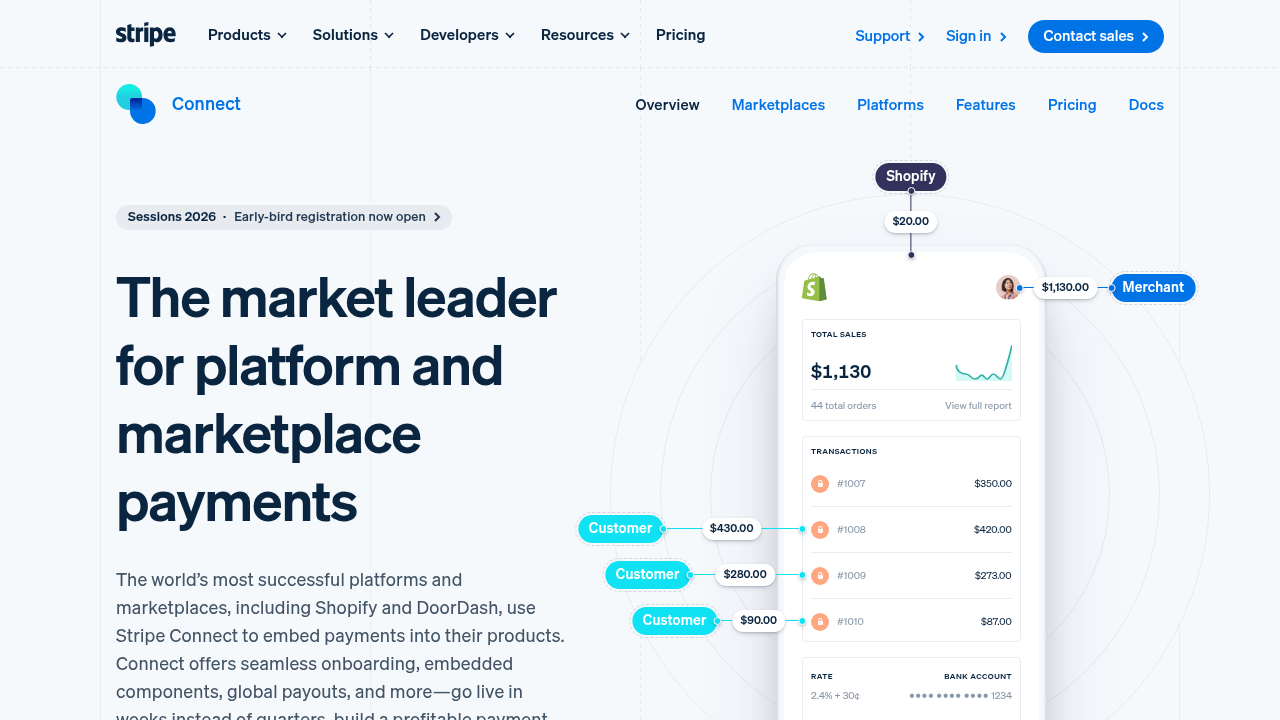
Stripe Connect provides payout infrastructure built around connected account models, primarily for marketplaces already using Stripe for payment acceptance. It includes automated 1099 generation for U.S. payees and integrates seamlessly with Stripe’s broader ecosystem.
The architecture works well when processing customer payments and disbursing to sellers through the same provider, with high-quality developer documentation and familiar branding that eases vendor adoption.
However, payouts are treated as an extension of payment acceptance rather than a dedicated disbursement system. Multi-speed ACH options, Same-Day ACH, and instant rails are limited, and international coverage, FX rates, and local rail support lag behind purpose-built global payout solutions. Pricing is less favorable for high-volume outbound payments, as the fee structure favors incoming transaction processing.
Connect is best for marketplaces already embedded in Stripe and primarily paying U.S.-based sellers. For dedicated mass-payout infrastructure with broader rail options, lower costs at scale, and API-first design, Routable provides a purpose-built solution.
Hyperwallet (PayPal)
Hyperwallet, part of PayPal, provides a global mass payout network covering 200+ countries, supporting PayPal transfers, prepaid cards, and digital wallets. PayPal’s brand recognition eases adoption, and drop-in UI components simplify integration.
All payee interactions occur within PayPal’s branded environment—white-label onboarding isn’t supported—limiting control for marketplaces or creator platforms that prioritize payout experience. Compliance, reconciliation, and ERP integration are basic, often requiring manual work.
Hyperwallet works when payees can remain in PayPal’s ecosystem. For custom-branded onboarding, unified mass payouts, and automated ERP sync, Routable provides a purpose-built alternative.
Tipalti
Tipalti is a global AP automation platform combining invoice processing, tax compliance, and contractor payouts across multiple currencies. It supports ACH, wire, and PayPal, along with invoice capture, PO matching, and traditional procurement workflows well-suited for finance-first teams with established AP processes.
However, its SOAP-based API limits developer flexibility, lacks idempotency keys, and doesn’t expose payee management, approval workflows, or tax collection via API. International coverage is narrower than purpose-built payout providers, and embedding Tipalti’s functionality into a product experience is challenging.
Tipalti works for teams prioritizing finance and procurement. For product-focused teams needing REST-first APIs, broader international reach, faster integration, and payouts embedded into the product experience, Routable offers a more developer-friendly solution.
BILL

BILL provides AP automation for SMBs, focusing on invoice capture, approval workflows, and vendor payments. Integrations with NetSuite and QuickBooks support traditional procurement cycles, and familiar workflows ease adoption.
However, BILL lacks webhooks, requiring polling or manual checks for payment status. International payments are limited, with complex multi-step flows, restricted SWIFT coverage, no automatic FX, and no W-8 collection for foreign payees. Its REST API is basic, with inconsistent patterns and rate limits, reflecting a finance-focused system designed for hundreds of invoices, not thousands of programmatic payouts.
BILL suits traditional SMB AP needs. For scalable, API-driven mass payouts with webhooks, international coverage across 220+ countries, automatic FX, and full tax form automation, Routable provides a purpose-built solution.
Trolley
Trolley serves internet economy businesses paying international contractors, with tax compliance at its core. It automates W-8/W-9 collection, IRS filing for 1099 and 1042-S forms, and supports payouts to 210+ countries.
Tax automation is Trolley’s strength for high-volume international contractors, and the API handles basic programmatic payout creation. However, a 100-payment-per-month minimum limits smaller or growing businesses. The system lacks true idempotency. External IDs help track payments, but duplicate prevention is manual. ERP integration is minimal, and multi-entity approval workflows are limited, leaving reconciliation work for accounting teams.
Routable removes these constraints with no payment minimums, automatic idempotency, bi-directional ERP sync, flexible multi-entity approvals, and bulk CSV uploads for thousands of payouts.
Checkbook.io
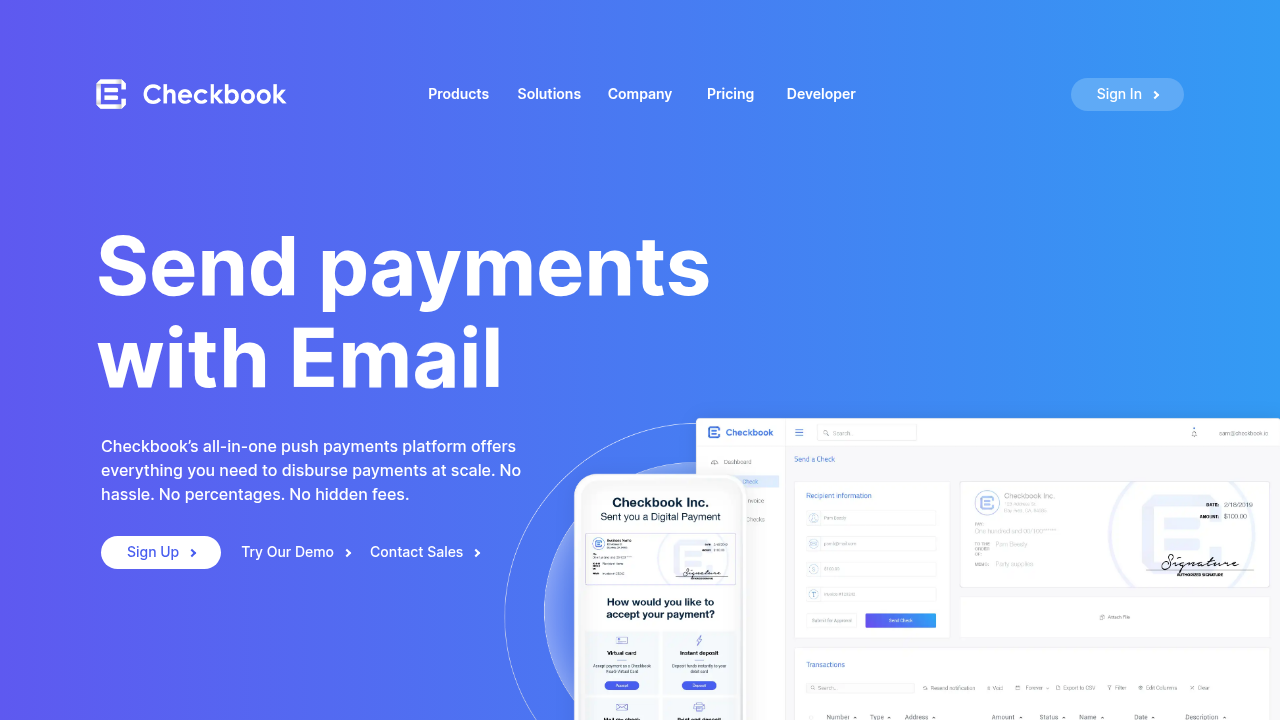
Checkbook.io provides a push-payment API for ACH and virtual card payouts, with quick sandbox testing and straightforward integration for basic disbursements. Instant virtual card issuance and Postman support speed up proof-of-concept work.
However, the system lacks tax compliance, bank verification, watchlist screening, and ERP connectivity. At scale, duplicate payment risk, manual compliance, and reconciliation create operational overhead.
Routable addresses these gaps with automatic idempotency, tax form collection, TIN validation, 6,000+ watchlist checks, bank verification, bi-directional ERP sync, and bulk CSV support for global payouts, scaling from hundreds to tens of thousands of payments.
Feature Comparison Table of High-Volume Payout Solutions
When you’re evaluating mass payout infrastructure, the differences between platforms become clear once you map out technical capabilities side-by-side. API design, payment speed, international coverage, and compliance automation separate purpose-built disbursement systems from adapted invoice processing tools.
This comparison focuses on the features that matter most for marketplaces, gig platforms, and creator networks processing thousands of monthly payments. We evaluated each solution based on how well it handles programmatic payouts at scale, not traditional accounts payable workflows.
Why Routable Is the Best High-Volume Payout Solution
Routable is built specifically for high-volume disbursement operations, not as an add-on to payment acceptance or invoice processing software. That purpose-built approach shows up in every part of the system.
The API integrates in less than 3 developer days with idempotency keys that prevent duplicate payments automatically. You get 14 webhook events for real-time status updates and documentation that eliminates constant support calls. When your engineering team needs to embed payout functionality directly into your product, the infrastructure actually supports it.
Payment flexibility sets Routable apart. It offers 10+ domestic rails including instant RTP and FedNow options that real-time payment adoption continues accelerating, Same Day ACH, and traditional options. International coverage reaches 220+ countries with 30-50% FX savings compared to standard rates. Your payees choose how they want to be paid, and you control costs while meeting diverse expectations.
The real advantage comes from operational completeness. White-label onboarding keeps payees in your branded experience rather than sending them to PayPal or generic portals. Automated W-9 and W-8 collection, TIN validation, 6,000+ watchlist checks, and 1099/1042-S filing happen without manual intervention. Bi-directional ERP sync maintains 99.8% accuracy, eliminating reconciliation work entirely.
For marketplaces, gig operations, and creator networks, the platform scales from thousands to tens of thousands of monthly payments without adding headcount, supporting faster payouts that directly impact partner retention.
Final Thoughts on Mass Payout Infrastructure
Choosing high-volume payout infrastructure comes down to whether the system was built for disbursements or adapted from invoice processing. You need idempotency protection, webhook-driven integrations, and payment rails that match what your creators or drivers expect. Routable was designed for product teams who embed payout functionality directly into their user experience, not finance departments managing traditional vendor payments.
FAQ
How do I choose the right high-volume payout solution for my business?
Start by evaluating your payment volume and growth trajectory. If you are processing 1,000 or more monthly payments or expect to reach that scale soon, dedicated disbursement infrastructure becomes necessary. Next, assess your technical requirements. Does your engineering team need an API-first architecture with idempotency protection, or will CSV uploads suffice? Finally, consider your payee network. International creators require different payment rails than domestic drivers, and gig workers increasingly expect same-day or instant payment options.
Which payout solution works best for marketplaces versus gig economy platforms?
Marketplaces with seller networks typically prioritize white-label onboarding, multi-currency support, and branded payee portals to keep the experience within their ecosystem. Gig economy platforms need faster payment rails like Same Day ACH or instant RTP/FedNow since driver and worker retention directly correlates with payout speed. Both benefit from API-first solutions with webhook support, but gig platforms should weight payment speed more heavily while marketplaces should focus on international coverage and FX rates.
What’s the difference between payout solutions and traditional AP software?
Traditional AP software focuses on invoice processing, purchase order matching, and approval workflows for procurement-driven payments. Payout solutions prioritize API connectivity, payment speed, payee experience, and the ability to send thousands of programmatic disbursements to creators, drivers, or sellers. If you’re calculating payment amounts in your own system and need to disburse funds at scale, you need payout infrastructure—not invoice management tools.
Can I start with a payout solution before reaching high volumes?
Most solutions allow you to start at any scale, though some impose minimums such as 100 payments per month. Look for providers without volume thresholds if you are currently processing 50 to 80 monthly payments but expect growth. Integration effort often matters more than current volume. If you will eventually need API-driven disbursements, webhook notifications, and automated tax compliance, it is better to implement that infrastructure early rather than migrate later when you are already at scale.
Why does idempotency matter for high-volume payments?
Idempotency keys prevent duplicate payments when network failures or timeouts cause your system to retry API calls. Without this protection, a single retry during a network hiccup can result in paying the same creator or driver twice. At scale, these duplicates create financial exposure and operational overhead tracking down and reversing erroneous payments—idempotency eliminates this risk automatically.