

Creator economies thrive on speed, scale, and trust—but paying thousands of creators accurately and on time remains one of the hardest operational challenges to get right. From revenue sharing and usage-based royalties to milestone and time-based payouts, modern platforms must support complex payout logic while meeting tax, compliance, and global payment requirements. Manual processes and generic payment tools quickly break down as creator networks grow, introducing errors, delays, and frustrated partners.
Creator payout automation platforms are purpose-built to solve this problem. They combine payout orchestration, compliance workflows, tax form collection, and mass payments into a single system designed for high-volume, recurring disbursements. This guide explores the leading creator payout automation platforms, the payment models they support, and how to evaluate them as your creator ecosystem scales from hundreds to tens of thousands of payees.
TLDR:
- Creator payout automation handles high-volume disbursements via API or CSV, not invoice processing
- Routable integrates in under 3 days with Same Day ACH, RTP, and 220+ countries in 140+ currencies
- Automated W-9 collection and 1099 filing removes compliance friction for scaling creator networks
- White-label onboarding with real-time tracking keeps creators informed on payment status
- Routable combines mass payout infrastructure with ERP sync for NetSuite, Intacct, and QuickBooks
What Are Creator Payout Automation Platforms?
Creator payout automation platforms are specialized software systems designed to handle the complex financial operations of paying content creators, freelancers, and digital contributors at scale. Unlike traditional payment tools, these platforms are built to manage high-volume, recurring payments while accommodating diverse payout models such as revenue shares, royalties, milestone-based payments, or time-based compensation. They provide a centralized system for automating calculations, disbursing funds across multiple currencies and payment methods, and ensuring that creators are paid accurately and on schedule.
Beyond simple payments, these platforms often include built-in compliance and tax management features, such as collecting W-9/1099 forms in the U.S., handling W-8/1042-S filing for international creators, and generating automated reports for bookkeeping and audits. By streamlining these workflows, creator payout automation platforms reduce errors, save time, and give organizations the confidence to scale their creator networks efficiently. For platforms with thousands—or even tens of thousands—of payees, this automation is essential to maintain trust, transparency, and operational efficiency.
Core Capabilities for Creator Payments
To identify the most effective tools for 2025, we focused on infrastructure that enables engineering-led payment flows rather than manual finance operations. Our evaluation relies on publicly available documentation and technical specifications, specifically targeting the needs of high-velocity marketplaces and gig economy payment solutions.
We assessed each solution against these core technical pillars:
- Developer Experience: Robust REST APIs, idempotency support, and webhooks that enable integration in days, along with native ERP compatibility for reconciliation.
- Global Rails: The ability to execute domestic (ACH, RTP, FedNow) and cross-border transfers through a single endpoint to reach creators anywhere.
- Compliance Automation: Automated collection of W-8/W-9 forms and KYC checks during onboarding to minimize regulatory risk.
- Payee Experience: White-labeled interfaces and real-time status tracking to ensure transparency for earners.
- Scalability: The capacity to execute tens of thousands of simultaneous transactions without performance degradation.
Best Overall Creator Payout Automation Platform: Routable
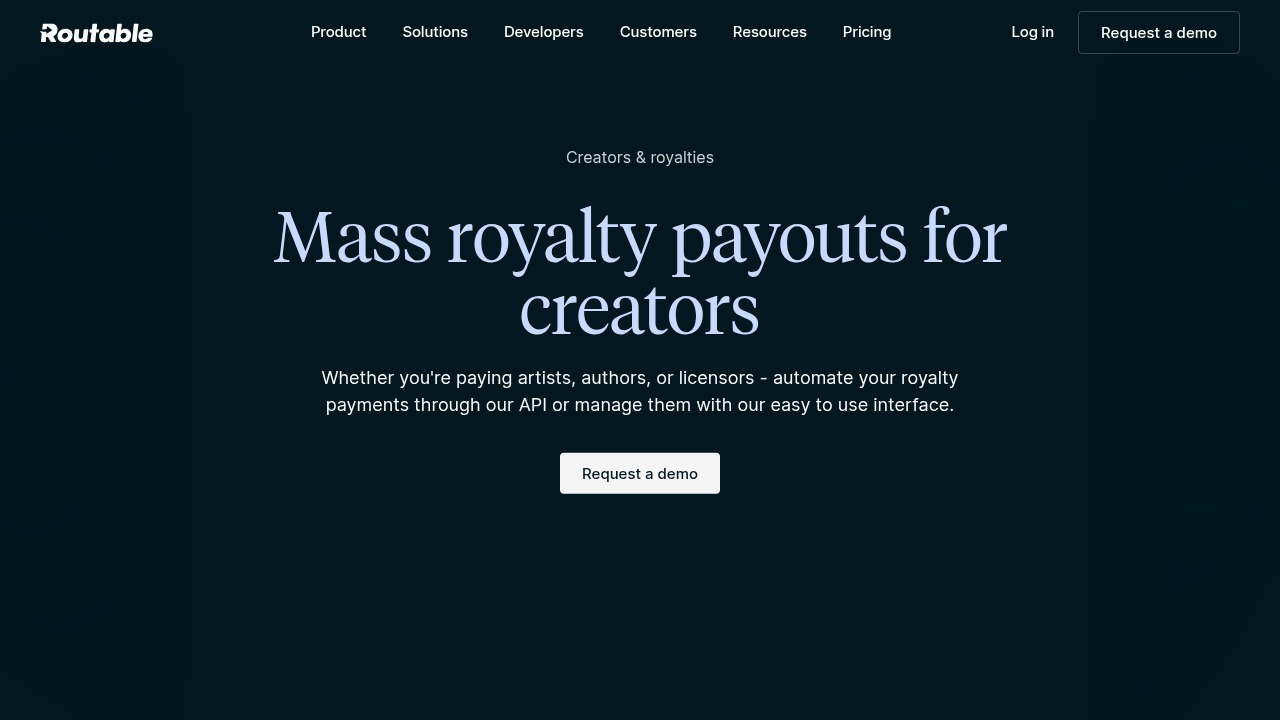
Routable is purpose-built for platforms where creator payouts are a core product feature. Routable’s infrastructure was architected from day one for high-volume programmatic disbursements. Engineering teams integrate in under 3 days, operations teams manage exceptions via CSV upload, and creators get paid through their preferred method without adding headcount as you scale from hundreds to tens of thousands of payees.
Key Capabilities:
- Same Day ACH, Real-Time Payments, push-to-card, and international rails across 220+ countries in 140+ currencies.
- White-label payee onboarding with automated W-8/W-9 collection, TIN validation, and 1099 filing.
- CSV upload option for operations teams alongside API flexibility for engineering.
- Bi-directional ERP sync with NetSuite, Intacct, QuickBooks, and Xero.
Bottom Line:
Routable is the only platform that combines enterprise-grade compliance automation with a developer experience that ships in days, not months. If your creators expect instant payouts, your finance team demands audit-ready records, and your engineering team needs reliable infrastructure that won’t break at scale—Routable delivers all three without compromise. Unlike competitors that force you to choose between speed, compliance, or developer experience, Routable was built to excel at all three simultaneously.
Stripe Connect
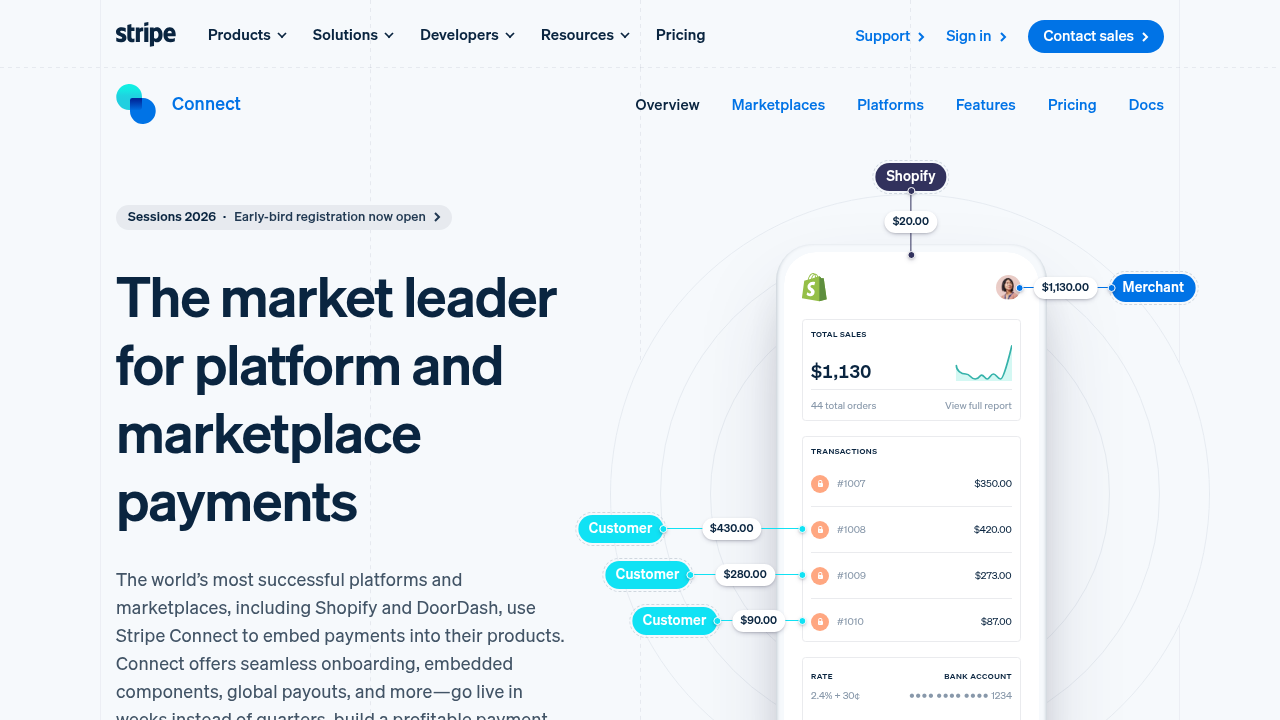
Stripe Connect provides infrastructure for marketplace and creator-economy businesses that manage funds across connected accounts. It allows platforms to accept a payment from a buyer and automatically route proceeds to sellers or creators within the same ecosystem via its payments API. Stripe Connect is particularly well suited to business models built around transaction-level revenue splits, rather than standalone mass payout workflows.
Key Capabilities:
- Connected account model tailored for marketplace payouts with embedded onboarding components.
- Tax automation for 1099-K reporting on qualifying transactions.
- Bank transfers and card payouts available in supported regions.
- Well-documented REST API with extensive libraries, webhooks, and testing environment.
Limitations:
Stripe Connect is primarily oriented around marketplace transaction splits and does not offer native support for more complex payment logic. Paying creators based on performance metrics, royalty calculations, or milestone completions that occur outside a transaction flow is not straightforward. Support for physical checks and broad instant payment coverage is limited, making the platform less suitable for payout programs with diverse payee preferences. Integration can also require a substantial engineering effort compared to purpose-built mass payout solutions. The system is largely optimized for U.S. payment rails, with more limited options for international disbursements than specialized global payout providers.
Bottom Line:
Stripe Connect works well for companies treating payouts as a feature of their payment acceptance flow. For operators needing end-to-end disbursement infrastructure with multiple rails, flexible workflows, and finance team alignment, Routable delivers broader functionality without requiring separate tools.
Hyperwallet (PayPal)
Hyperwallet, acquired by PayPal in 2018, provides global mass payout infrastructure primarily designed to leverage PayPal’s extensive network reach. It serves marketplaces and gig platforms that prioritize speed-to-market and want to tap into PayPal’s 400+ million active accounts worldwide. The platform is optimized for companies where the majority of payees already use or prefer PayPal as their primary payment method.
Key Capabilities:
- Global reach allowing disbursements to PayPal accounts, local bank accounts, and prepaid cards.
- Embedded UI components (drop-in widgets) to speed up front-end implementation.
- Support for multiple currencies across 200+ markets.
- Deep integration with the existing PayPal ecosystem for familiar payee access.
Limitations:
Hyperwallet often locks payees into the PayPal ecosystem, making it difficult to offer a fully white-labeled experience that reinforces your brand. From a technical standpoint, the system provides minimal control over reconciliation and lacks bi-directional ledger sync capabilities. Compliance management tools are also basic compared to specialized payout infrastructure.
Bottom Line:
Hyperwallet delivers speed and access to the PayPal network but sacrifices control and branding. For operators building differentiated payee experiences with custom workflows and deep accounting integration, Routable provides the flexibility and technical safeguards that Hyperwallet cannot match.
Checkbook
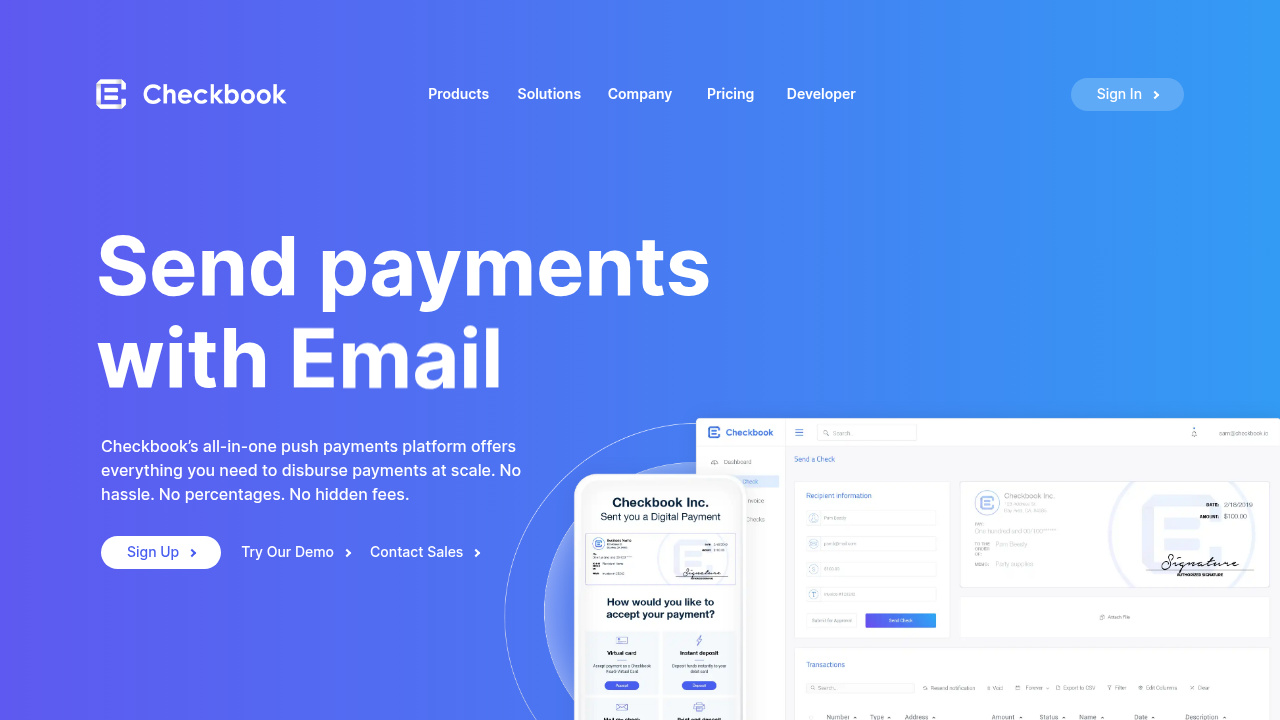
Checkbook positions itself as the digital replacement for paper checks, offering a lightweight API for ACH transfers, virtual cards, and email-based check delivery. Built for simplicity over comprehensiveness, it targets companies looking to quickly digitize basic payment workflows without the complexity of enterprise-grade infrastructure. The platform appeals to teams that need to move money fast but don’t require the compliance automation, operational controls, or payment rail diversity that high-volume creator platforms demand.
Key Capabilities:
- Simple REST API for executing ACH and check disbursements with basic authentication.
- Virtual card and push-to-card functionality.
- Quick sandbox testing environment for engineers.
- Postman collections available for immediate testing.
Limitations:
Checkbook offers lightweight functionality but lacks the compliance infrastructure required for scaling creator payouts. The system does not automate tax form collection, TIN validation, or global watchlist screening, placing the regulatory burden back on your operations team. It also lacks deep ERP connectivity and tools for managing high-volume batch workflows.
Bottom Line:
Checkbook handles simple payment scenarios but falls short for creator operations requiring compliance at scale. While it moves money effectively, Routable provides the full compliance stack, advanced operational controls, and robust accounting integrations that Checkbook cannot match.
Trolley
Trolley targets the internet economy with infrastructure designed for global disbursements and tax compliance. Their system handles recipient management and payout creation through an API, offering coverage in 210+ countries with local payment methods. A key feature is their automated tax compliance engine, which manages W-8 and W-9 collection along with IRS filing support for both domestic and international payees.
Key Capabilities:
- Global coverage across 210+ countries with local payment methods including ACH, SWIFT, and regional rails.
- Automated W-8/W-9 collection with IRS filing support for 1099-NEC, 1099-MISC, and 1042-S.
- Developer-friendly endpoints for creating payouts, managing recipients, and tracking payments.
- CSV upload and API-driven bulk payment creation.
Limitations:
Trolley imposes a strict minimum of 100 payments per month, which excludes companies with fluctuating volumes or early-stage growth. The system offers limited support for multi-entity structures and lacks the sophisticated approval workflows found in enterprise-grade tools. Crucially for developers, Trolley does not support true idempotency; it relies on an optional external ID field that does not automatically prevent duplicate transactions during network failures. Its ERP integration capabilities are also less robust than those of comprehensive finance solutions.
Bottom Line:
Trolley manages global tax compliance effectively but falls short on operational depth. For operators who require flexible payout orchestration without volume minimums, along with advanced approval controls and deep ERP synchronization, Routable provides the end-to-end functionality that Trolley cannot match.
BILL

BILL is primarily an accounts payable automation solution designed for traditional finance teams managing supplier invoices. While it is a staple in many back offices for bill pay, its architecture focuses heavily on manual workflows rather than programmatic mass disbursements.
Key Capabilities:
- Automated invoice capture via email, mobile app, or direct upload with OCR data extraction.
- Multi-level approval routing based on amount thresholds, departments, or GL codes.
- Domestic payment processing via ACH and physical checks.
- Integrations with NetSuite, Sage Intacct, and QuickBooks
Limitations:
BILL presents significant technical hurdles for creator payouts. It lacks webhooks entirely, which prevents engineering teams from building real-time status updates into their product. International payment capabilities are restrictive, often requiring manual intervention, and the system lacks automatic currency conversion or broad SWIFT coverage. From a developer perspective, the API documentation is sparse, and the endpoints use inconsistent REST standards. The absence of granular token permissions and standardized error codes makes building a reliable, automated integration difficult.
Bottom Line:
BILL is a strong choice for traditional accounts payable, but it fundamentally mismatches the needs of platforms treating payouts as a product feature. The absence of webhooks alone disqualifies it for any customer-facing payment experience, while the invoice-centric architecture creates friction for performance-based or royalty-driven payout models.
Tipalti
Tipalti provides global mass payment capabilities primarily for enterprise accounts payable departments. It focuses on automating the entire cycle of cross-border remittances, from supplier onboarding to tax compliance, specifically for finance organizations managing complex international supply chains.
Key Capabilities:
- Global tax compliance covering W-8, W-9, and VAT requirements.
- Multi-currency disbursement capabilities across 190 countries.
- Built-in AML screening and regulatory compliance checks.
- Integrations with major ERP systems like NetSuite and Oracle.
Limitations:
Tipalti presents technical challenges for developer-led integrations. The architecture relies on a hybrid of REST and outdated SOAP endpoints, creating friction for engineering teams accustomed to standard RESTful designs. The system lacks true idempotency keys, forcing developers to rely on manual reference codes for transaction tracking. Ledger control is rigid, and basic operations like collecting payee bank details or creating single payments involve unnecessary complexity. The API also does not support approval workflows or embedded tax information collection, limiting how much of the experience you can build directly into your own product.
Bottom Line:
Tipalti is built for the finance back office, not for product teams building agile payout experiences. For operators who need a clean, consistent API that allows for fast iteration and seamless integration, Routable offers the developer-centric infrastructure that Tipalti cannot provide.
Feature Comparison Table of Creator Payout Solutions
When choosing infrastructure for high-volume creator payments, the differences between platforms become clear when you compare their technical foundations side-by-side. The table below highlights the core capabilities that matter most for engineering teams building scalable payout experiences: Webhook support for real-time status updates, idempotency protection against duplicate payments, and the payment rails needed to meet diverse creator preferences.
Why Routable Is the Best Option for Automating Creator Payouts
Most payment platforms force you to choose: build fast with limited rails, get compliance right but sacrifice developer experience, or support global payouts while drowning in manual reconciliation. Routable is the only infrastructure that delivers all three without compromise.
Routable was purpose-built for large-scale payouts, rather than adapted from invoice workflows or basic marketplace split models. This foundation enables faster implementation, wider payment rail coverage, and the ability to process more than 10,000 monthly payments via API or CSV without adding operational headcount.
Routable simplifies influencer payments by eliminating the bottlenecks that often slow payouts. Tax collection and watchlist screening are handled automatically and in real time, reducing delays that leave creators unpaid. The platform also supports the full range of payment methods influencers expect, while delivering real-time visibility that helps strengthen trust with partners.
Final Thoughts on Creator Payment Infrastructure
Choosing the right influencer payment solution means finding infrastructure that handles both the technical and operational sides of disbursements. You need something that scales with volume, automates compliance, and gives your creators visibility into their payments. We built Routable to be that solution for companies where payouts are a competitive advantage and a diver of growth.
FAQ
How do I choose the right creator payout automation tool for my business?
Start by evaluating your technical requirements. Does your engineering team need a robust API with webhooks and idempotency support, or will your operations team primarily rely on CSV uploads? Next, assess your payee base. If you are managing international creators, look for solutions that offer broad currency coverage and automated tax compliance. Finally, consider your growth trajectory and select infrastructure that can handle high volumes without requiring additional headcount as you scale.
Which creator payout solution works best for companies just starting to automate payments?
For early-stage companies with straightforward domestic disbursements, Checkbook or Stripe Connect offer quick implementation with minimal complexity. However, if you anticipate rapid growth, international expansion, or need compliance automation from day one, starting with Routable prevents costly migrations later. The key is matching your current volume with your 12-month projection, tools with minimum payment requirements like Trolley may not fit fluctuating early-stage volumes.
Can I use these platforms if my creators prefer different payment methods?
Yes, but coverage varies across platforms. Routable supports Same Day ACH, Real-Time Payments, push-to-card, checks, and international rails in 140+ currencies, giving creators maximum flexibility. Hyperwallet locks payees into the PayPal ecosystem, while Checkbook focuses primarily on ACH and virtual cards. If your creator base demands choice, with some wanting instant payments and others preferring bank transfers, select a solution that offers multiple rails through a single integration.
What’s the difference between marketplace payment tools and mass payout infrastructure?
Marketplace payment tools like Stripe Connect focus on splitting funds between buyers and sellers within a transaction flow, handling payment acceptance and distribution simultaneously. Mass payout infrastructure like Routable is purpose-built for high-volume disbursements independent of payment acceptance, offering deeper compliance automation, broader rail coverage, and controls for finance teams. If you’re paying thousands of creators based on performance metrics as opposed to individual transactions, mass payout infrastructure is the better fit.
Why does idempotency support matter for creator payments?
Idempotency keys prevent duplicate payments during network failures or API retries, making them a critical safeguard when processing thousands of disbursements. Without this feature, a connection timeout could result in paying the same creator twice, leading to reconciliation issues and eroding trust. Routable, Stripe Connect, and a few other platforms support true idempotency, while tools such as Trolley, BILL, and Tipalti lack this protection, forcing teams to build manual safeguards or accept the risk of duplicate transactions.